

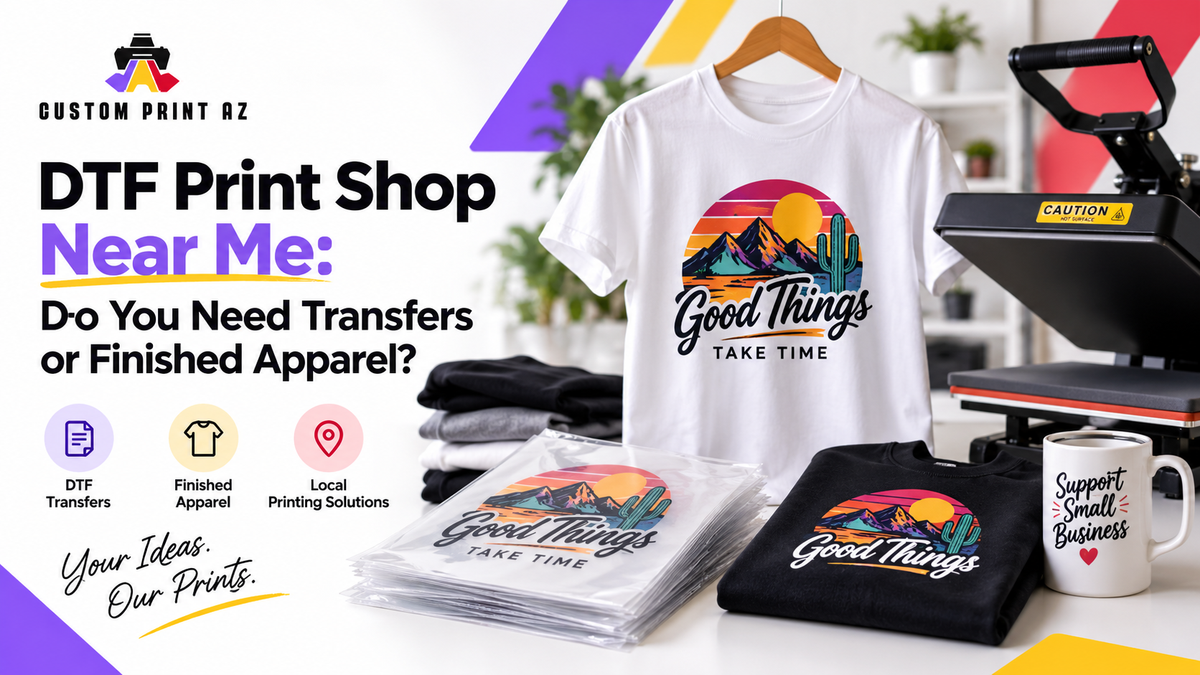
Searching for a “DTF print shop near me” can sound like a straightforward task, but the phrase can lead to two different service expectations. You may want printed DTF transfers that you will apply to your own blank garments, or you may be looking for finished apparel with the design already applied.
Those needs involve different production workflows. With a transfer-only order, the printed transfer is the product you receive, and garment application still happens afterward. With finished decorated apparel, the expected output is a garment with the design already applied.
That means the first question should not be “Which print shop is best?” A more useful question is: Will pressing still need to happen after I receive my order? The answer can quickly clarify which type of service you should be looking for and help you avoid researching a service that stops at the wrong stage of your workflow.
Start by Defining What You Want to Receive
When you open a DTF print shop page, look beyond the shop name or the phrase “DTF printing.” Start with the physical product you expect to receive at the end of the order.
In a transfer-only workflow, you receive printed DTF transfers that still need to be applied to garments. The artwork has been produced as a transfer, but the apparel production process is not necessarily finished. Matching the transfer with the correct garment, positioning it, pressing it, and completing your own production workflow happen afterward.
In a finished-apparel workflow, you are not expecting a transfer as the final product. You expect to receive a garment with the design already applied. Other parts of the service, such as blank garment sourcing, additional finishing, or fulfillment, can vary by provider and should not be assumed simply because a business offers finished decorated apparel.
This distinction matters when searches such as “dtf print shops near me” or “dtf shop near me” return businesses using similar DTF terminology. Two pages may both discuss DTF printing while offering different physical outputs.
What Does a Transfer-Only DTF Order Mean?
With a transfer-only order, the print shop produces the DTF transfer from your artwork. The physical product you order is the printed transfer rather than a completed T-shirt, hoodie, or other decorated garment.
This workflow can make sense when you want to keep the garment-application stage within your own production process. You may already have blank garments, access to a heat press, or an established pressing workflow. In that situation, you may not be looking for a shirt-printing service at all. You may simply need the transfer-production stage completed for you.
One important distinction is the meaning of “ready-to-press.” A ready-to-press transfer should not be confused with finished apparel. It refers to a transfer intended for the garment-application stage; it does not mean that the design has already been applied to a garment. If you want to explore how this type of order fits into an apparel production process, the guide to ready-to-press DTF transfer workflows covers that workflow in more detail.
Before placing a transfer-only order, it helps to have your final artwork, required transfer sizes, and quantities organized. But those details come after the more fundamental decision: do you want to receive transfers and continue production yourself, or do you expect to receive completed decorated apparel?
Why Is Finished Decorated Apparel a Different Service?
The key difference is the expected physical output. With transfer-only DTF printing, the transfer is what you receive. With finished-apparel service, the expected output is not merely a transfer; it is a garment with the design applied.
That does not mean every business offering finished apparel provides the same additional services. Blank garment sourcing, finishing, packing, fulfillment, or other steps can vary from one provider to another. Those details should be verified from the actual service description rather than inferred from the phrase “finished apparel.”
Similarly, not owning a heat press does not automatically make a transfer-only order the wrong choice. The important question is who will handle the garment-application stage. If you do not have your own pressing equipment, team, or another plan for application, receiving transfers alone leaves an additional production step to complete.
On the other hand, owning a heat press does not automatically mean transfer-only printing is always the right choice. What matters is whether you actually want to manage the blank garments and application process yourself. The service should match the part of production you want to keep in your own workflow.
The Key Question: Will Pressing Still Need to Happen?
You can reduce the entire decision to one practical question: After the order is delivered, does the design still need to be heat pressed onto the garment?
- Yes: You are likely looking at a transfer-only DTF workflow. The printed transfer is delivered, and garment application remains a later production step.
- No: If you expect the design to arrive already applied to the garment, you are looking for a finished decorated apparel service. Confirm that the shop explicitly offers that scope.
This question makes a “near me” search more useful because distance and business names do not explain service scope. A company that provides DTF printing does not necessarily apply every transfer to a garment. Likewise, a shop that offers completed apparel may not be the most direct ordering route for someone who only needs transfers for an existing pressing operation.
The goal is not to decide which model is universally better. It is to identify where you want the provider's work to end and where your own production process should begin.
If You Have Blank Garments and a Pressing Workflow, What Should You Look For?
If you manage your own blank garments and want pressing to remain part of your production process, a transfer-only service may align more directly with what you need. The deciding factor is not simply whether you own a heat press. It is whether you want garment application to remain inside your workflow.
Searches and service pages that focus on terms such as DTF transfers, DTF transfer printing, ready-to-press DTF transfers, or DTF print services may be more relevant when the transfer itself is the product you want to order.
For example, imagine that you already source your own T-shirts, manage garment sizes for your customers, and schedule pressing as part of your production process. Receiving only the transfers is not an incomplete service in that workflow. The transfer is the production input you intended to purchase.
If you have no plan for the garment-application stage, however, the same transfer can leave you with unfinished work. That is why your own workflow matters more than the wording of the search query alone.
How to Read the Service Scope on a DTF Print Shop Page
This is not a checklist for ranking the “best” DTF print shop. Instead of comparing price, minimum order quantities, turnaround times, or suppliers, focus on understanding what the page is actually allowing you to order.
If a page emphasizes artwork uploads, transfer dimensions, transfer quantities, gang sheets, or ready-to-press transfers, the order may be focused on the transfer itself. In that case, check the service description to determine whether garment application remains a separate step.
If a page explicitly discusses garment types, apparel decoration, or applying the design to garments, it may describe a broader service scope. Even then, do not assume that blank garment sourcing, finishing, fulfillment, or other services are included unless the provider says so.
Three questions can help you interpret the page:
- Is the physical product I am ordering a transfer or a decorated garment?
- When I receive the order, will garment application still need to happen?
- Does the service stop at the same production stage where I want to take over?
These are not supplier-ranking criteria. They simply help you determine whether the service scope matches your workflow before you move deeper into the ordering process.
If your requirement is to receive printed transfers and continue garment application within your own workflow, you can review the available DTF transfer printing options from Custom Print AZ.
Turn Your Need Into a One-Sentence Production Brief
Before moving through search results, try describing your order in one sentence. This makes it easier to compare what you need with what a service page actually offers.
A transfer-only requirement might sound like this: “My final artwork is ready, I already have the blank garments, and I only need printed transfers that I will press myself.”
A finished-apparel requirement might sound like this: “My artwork is ready, but I want to receive the garments with the design already applied.”
Those two statements begin with similar artwork but end at different points in the production process. That difference is more useful than treating every “DTF print shop near me” result as though it provides the same output.
A short production brief can also help when more than one person is involved in an order. Saying “we ordered DTF printing” can be ambiguous. Saying “we ordered printed transfers that our team will apply” or “we need the design applied to the garments before we receive them” makes the expected handoff much clearer.
Transfer-Only or Finished Apparel? Follow the Handoff
Another way to make the decision is to identify the handoff point between the print shop and your own workflow.
With transfer-only printing, the handoff happens when you receive the printed transfer. Your next task is garment application. With finished decorated apparel, the expected handoff happens later: you receive the garment after the design has already been applied.
This handoff perspective is useful because it keeps the decision focused on production responsibility rather than broad supplier comparisons. You do not need to rank shops or compare unrelated service features to answer the first question. You only need to understand what the provider hands to you and what work remains afterward.
Once that is clear, details such as artwork preparation, quantity, order format, garment planning, and production scheduling become easier to evaluate in the correct context.
Frequently Asked Questions
Does ordering from a DTF print shop mean a T-shirt is included?
Do not assume that it does. With a transfer-only service, the product you receive is the printed DTF transfer. Whether garments or garment application are included depends on the service scope described by the provider.
Does ready-to-press DTF mean finished apparel?
No. Ready-to-press describes a transfer intended for the garment-application stage. It does not mean that the transfer has already been applied to a garment.
If I own a heat press, should I look for a transfer-only service?
Owning a heat press alone does not determine the right service. If you want to manage your own blank garments and apply the transfers within your production workflow, transfer-only DTF printing may be a more direct fit. If you want garment application completed as part of the order, verify the finished-apparel service scope instead.
How can I tell whether a DTF shop offers finished apparel?
Look for a clear description of what the customer receives. Do not rely on the phrase “DTF printing” alone. If you need completed decorated garments, confirm that garment application is explicitly part of the service.
What should I ask myself before searching for DTF print shops near me?
Start with the expected handoff: do you want to receive printed transfers and handle garment application afterward, or do you want the design already applied to the garment? That answer defines the type of service you should investigate.
Define the Output Before You Choose the Shop
The easiest way to make a “DTF print shop near me” search more useful is to define what you want to receive before comparing service pages. If your requirement is “send me the printed transfers and I will handle the garments,” you are looking for a transfer-only workflow. If your requirement is “send me the garments with the design already applied,” you need to verify a finished-apparel service.
Neither route is automatically better. They simply end at different stages of production. Understanding that distinction helps you evaluate search results according to the work you actually need completed instead of assuming that every DTF print shop offers the same deliverable.
If transfer-only printing matches your workflow, the next step is to prepare your artwork, sizes, and quantities and review the transfer-ordering options that fit the job. If you need finished decorated apparel instead, confirm that garment application is explicitly included before treating a print shop page as a match for your order.