

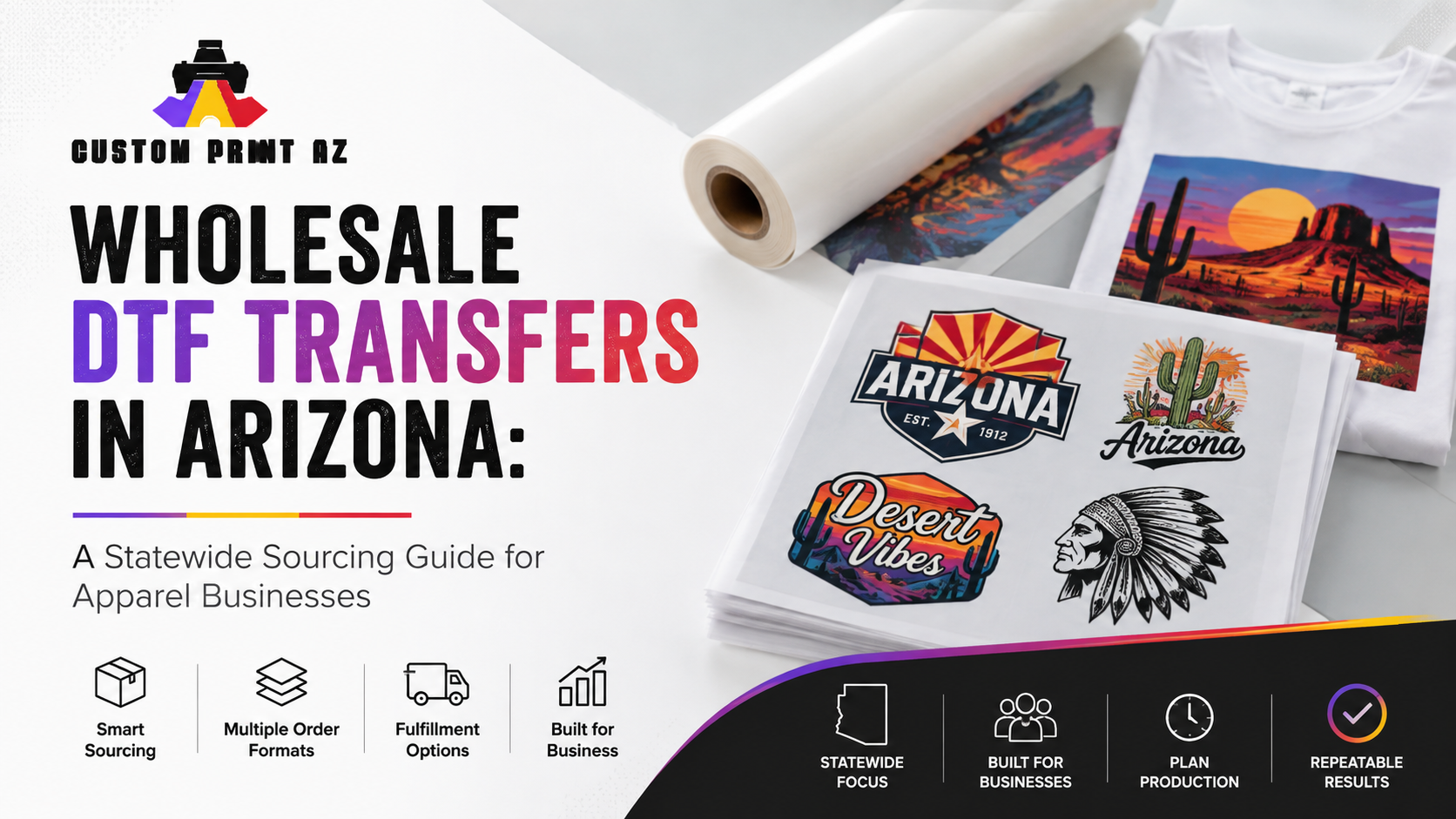
Wholesale DTF transfers in Arizona make the most sense when a business needs a dependable way to source transfers across repeated jobs, changing quantities, or multiple customer accounts. The key decision is not simply how many transfers to buy. It is how artwork, order format, fulfillment, inventory, and pressing fit into the larger apparel operation.
Arizona buyers who already know what they need can begin with Custom Print AZ or review the dedicated wholesale DTF transfer options. Businesses still deciding how to structure recurring production can use this guide to build the sourcing plan first.
Arizona Wholesale DTF Is a Supply Decision, Not Just a Volume Decision
The word wholesale often makes buyers think about quantity first. For an apparel business, however, the bigger question is whether the transfer supply system can support the way the company actually sells and produces garments.
A business printing one large event order has different needs from a shop that serves dozens of repeat customers. An apparel brand releasing scheduled collections has different priorities from a reseller that keeps several core graphics available throughout the year.
That means a useful wholesale DTF plan should answer more than, “How many transfers should we order?” It should also answer:
- How predictable is demand?
- How many designs are active at the same time?
- Which graphics repeat and which are one-time projects?
- Does the business want finished transfer inventory on hand or prefer to order closer to production?
- Who controls the artwork and final dimensions?
- Which order format creates the cleanest path from approved design to heat press?
- How does fulfillment fit the production calendar?
Thinking at this level separates a wholesale sourcing system from a single bulk purchase.
Choose a Sourcing Model Before You Choose an Order Format
Arizona businesses can approach wholesale DTF in several ways depending on how demand reaches the production floor. The right model should follow the sales pattern of the business rather than forcing every job into one ordering routine.
Made-to-Order Sourcing
In a made-to-order model, the business waits until a customer order, merchandise sale, or production request is confirmed before purchasing the required transfers.
This can make sense when artwork changes frequently, demand is difficult to predict, or the business wants to limit transfer inventory. The tradeoff is that transfer sourcing becomes part of the timeline for every production cycle.
For this model, organization matters more than stocking large quantities. Approved artwork, dimensions, and quantities should be ready as soon as the customer job is confirmed.
Planned Replenishment
Some businesses repeatedly use the same designs. Staff logos, core brand graphics, standard merchandise artwork, and repeat customer designs may need replenishment throughout the year.
These businesses can treat transfers more like production inventory. Instead of rebuilding the purchasing decision every time, the company tracks which graphics are consumed regularly and determines when another batch should be sourced.
The important question becomes: Which designs deserve planned inventory? A design that moves constantly can justify a different purchasing process from a graphic that may never be used again.
Campaign or Project Sourcing
Events, seasonal launches, team orders, promotional campaigns, and merchandise drops may create a concentrated period of demand rather than continuous usage.
For these projects, the business can organize the entire transfer requirement around the campaign. Artwork approval, design variations, projected garment counts, and transfer quantities should be locked before the job reaches production.
The focus is not replenishing permanent stock. It is making sure the transfer order supports the complete project without creating unnecessary leftovers or shortages.
Mixed-Account Production
Many print shops operate all three models at once. One customer may reorder the same logo every month, another may place a single event order, and a third may need several graphics in changing quantities.
This is where wholesale DTF sourcing becomes a systems problem. The shop needs a method for separating customer artwork, quantities, deadlines, and reorder behavior so unrelated jobs do not become one confusing production batch.
Map the Job Before It Reaches the Transfer Printer
A wholesale purchasing system works better when transfer ordering begins with a production map rather than a folder full of artwork.
For each job, identify the information the press operator will eventually need. That usually means understanding the design, intended dimensions, quantity, garment placement, and which customer or production batch the transfer belongs to.
A practical job record can include:
- customer, brand, or project name,
- approved artwork identifier,
- transfer dimensions,
- quantity required,
- intended garment placement,
- production or event date,
- whether the graphic is expected to repeat,
- and the chosen transfer order format.
This does not need to become a complicated software project. The objective is simply to stop important production decisions from living only in emails, text messages, handwritten notes, or someone’s memory.
The more orders a business processes, the more valuable this separation becomes. A clear record also makes it easier to recognize which designs should be treated as recurring production assets and which belong only to one project.
Use the Order Format That Matches the Structure of the Work
Wholesale does not require every buyer to use the same transfer format. The useful question is which route makes the artwork easiest to order, receive, identify, and press.
Transfers by Size
Best suited for: jobs where a design already has a defined physical size and the required quantity is easy to count.
This route can be practical for a recurring logo, a single campaign graphic, or a project where the buyer does not need to combine multiple pieces of artwork on one sheet.
Once the final dimensions and quantity are confirmed, buyers can use the DTF transfers by size order route.
Prepared Gang Sheet Upload
Best suited for: print businesses or designers that already prepare the complete sheet layout before ordering.
Uploading a finished gang sheet gives the buyer direct control over which graphics share the sheet and how the layout is organized. That can be useful for production teams that already have their own file-preparation system.
Before using this approach, verify that the sheet itself is the final production file. If the layout still requires size changes, artwork substitutions, or quantity adjustments, those decisions should be resolved first.
Businesses with a completed layout can use the DTF upload gang sheet route.
Gang Sheet Builder
Best suited for: buyers who know which designs and quantities they need but want to assemble the sheet during the ordering process.
This route can fit mixed artwork, repeated logos, multiple dimensions, and jobs where several transfer types belong in the same planned production batch.
The important distinction is that a gang sheet should solve an organizational or production need. Filling every available space is not the only measure of efficiency. A sheet that is difficult to cut, sort, or identify later can create extra labor after it reaches the apparel shop.
Buyers who need to arrange multiple graphics can use the DTF gang sheet builder.
Standardize the Information That Should Not Change
Growing apparel operations often lose time because the same decisions are repeatedly made from scratch.
If a customer has already approved a logo, the business should know which file is the approved version. If a graphic is regularly produced at a particular dimension, the previous production size should be easy to find. If several designs belong to one account, the relationship between them should be obvious.
Useful information to standardize can include:
- approved artwork naming,
- customer or account identifiers,
- previously used transfer dimensions,
- common garment placements,
- design families that are normally ordered together,
- and a record of which files are active versus retired.
Standardizing this information does not mean freezing every future order. Quantities change. Garments change. A customer may request a different placement or revise a logo.
The purpose is to preserve reliable production history so the next order begins with known information instead of reconstruction.
Keep the Variables Flexible
A repeatable wholesale system should still leave room for project-specific decisions.
Transfer quantity should reflect current demand, not the size of the previous order automatically. A graphic that was used on a large campaign last season may need only a small quantity this time. A logo previously printed for one garment placement may need different dimensions for a new product.
This creates a useful distinction:
Standardize the identity of the job. Reconfirm the requirements of the job.
The approved file, customer name, and production history can remain organized. Quantity, dimensions, deadline, garment use, and order format should still be reviewed before each new production cycle.
Arizona Geography Changes the Fulfillment Question
Wholesale DTF sourcing looks different depending on where the buyer operates and how much time remains between transfer production and finished-garment delivery.
Custom Print AZ operates from 3411 E Corona Ave #108, Phoenix, AZ. Local pickup is available for Phoenix-area customers. That gives nearby businesses an additional fulfillment option when coordinating transfer production with their own pressing schedule.
For buyers elsewhere in Arizona, the more useful planning question is when the transfers must be available at the business location. That date should come before the final garment deadline because the buyer still needs time for pressing, inspection, sorting, packing, or any other finishing work required by the project.
A statewide production plan should therefore distinguish between:
- the customer or event deadline,
- the date finished garments must be completed,
- the date transfers need to be available for pressing,
- and the date the transfer order needs to be finalized.
This protects the apparel production window instead of treating transfer completion as the end of the job.
Compare Wholesale DTF Vendors by Operational Fit
A useful wholesale supplier is one that fits the buyer’s operating model. A page labeled “wholesale” is not enough information to make that decision.
Arizona businesses comparing DTF sourcing options can evaluate a supplier through several operational questions.
Can the Ordering Method Match Different Types of Work?
A business may need individual transfers for one customer and gang sheets for another. Multiple order routes can be useful when a company handles different production structures instead of one standardized job.
Is the Artwork Responsibility Clear?
The buyer should understand what needs to be finalized before production begins. Unclear artwork, unresolved sizes, or uncertain quantities can create problems regardless of order volume.
Can Repeat Jobs Be Reconstructed Reliably?
A recurring customer should not require a complete investigation every time another batch is needed. The buyer’s own records should make it possible to identify the approved design and previous production decisions quickly.
Does Fulfillment Fit the Press Schedule?
The transfer order has to arrive early enough for the buyer to complete the garment production stage. A supplier relationship becomes more useful when fulfillment is planned as part of the full job rather than considered only after artwork is submitted.
Is There a Clear Path From Research to Ordering?
The buyer should be able to move from understanding the options to selecting the appropriate commercial route without confusing an educational guide with a product configurator.
Evaluate Cost Beyond the Price of One Transfer
Wholesale purchasing naturally involves cost, but the lowest visible transfer price does not describe the full production cost of an apparel job.
Businesses should also consider the work created around the transfer.
Examples include:
- time spent rebuilding old artwork decisions,
- unused transfers created by poor quantity planning,
- labor spent sorting an unnecessarily complicated gang sheet,
- rush situations caused by late replenishment,
- reprinting caused by incorrect dimensions,
- and time lost when customer jobs are not clearly separated.
This does not mean every business should carry large transfer inventories. Excess inventory can create its own waste, especially for seasonal designs or customers who change branding frequently.
The better objective is controlled purchasing: enough information to buy for the actual production model without treating maximum quantity as the goal.
When Wholesale DTF May Not Be the Right Starting Point
Not every DTF project needs a wholesale system.
A one-time project with one design and a small known quantity may be easier to handle as a straightforward transfer order. A business still testing a new logo size may want to confirm the production decision before building larger inventory around it.
Wholesale planning is also premature when basic job information is unresolved. Increasing quantity does not fix uncertain artwork, unknown dimensions, incomplete customer approval, or a production schedule that has not been established.
Businesses still deciding whether DTF itself is the right decoration method should solve that question before building a wholesale purchasing model.
The point of wholesale sourcing is to support repeatable or larger-scale apparel work. It should remove friction from an established process rather than make a simple project more complicated.
What Different Arizona Buyers Should Optimize
Print Shops
A print shop serving many accounts should prioritize job separation and repeatability. Customer artwork, transfer dimensions, quantities, and reorder behavior should remain easy to distinguish even when several orders are being prepared at the same time.
The most valuable wholesale system for a print shop may be the one that reduces administrative work between customer approval and pressing.
Apparel Brands
An apparel brand may have fewer unique customers but a more predictable design catalog. Core graphics, seasonal designs, limited releases, and new-product testing may all require different inventory decisions.
The brand should identify which transfers behave like repeat production assets and which should remain project-based.
Merchandise and Resale Businesses
Businesses selling decorated products can benefit from separating transfer inventory from finished-garment inventory. The production model may allow the company to hold approved designs as transfers and press garments according to actual demand.
Whether that model is appropriate depends on the business’s own garment inventory, order frequency, pressing capacity, and fulfillment process.
Organizations, Teams, and Project Buyers
An organization may not need ongoing wholesale inventory at all. The more important task may be organizing one large project correctly: final artwork, approved quantities, required dimensions, and enough production time to complete the garments before the event or distribution date.
Phoenix Has a Different Wholesale Decision Layer
Arizona-wide sourcing and Phoenix-local production should not be treated as the same decision.
At the statewide level, buyers are comparing how wholesale DTF fits their supply model, production frequency, order format, fulfillment needs, and business structure.
Phoenix businesses have an additional local factor because Custom Print AZ’s production location is in Phoenix and local pickup is available. For buyers whose workflow depends specifically on Phoenix pickup, local production timing, and repeat apparel-shop operations, the Phoenix wholesale DTF guide covers that city-level use case in more detail.
Keeping the two decisions separate makes the buying process clearer. Arizona businesses can use the statewide sourcing framework to choose how wholesale DTF fits the company, while Phoenix buyers can go deeper into the local operating workflow when that information is relevant.
A Statewide Wholesale DTF Buying Checklist
Before moving an Arizona wholesale DTF project into production, confirm the following:
- The final artwork has been approved.
- Each design has an identified production use.
- Required dimensions have been confirmed for the current job.
- Quantity has been calculated by design and size.
- Recurring designs are separated from one-time artwork.
- The business has chosen transfers by size, an uploaded gang sheet, or a builder-based gang sheet based on the actual order structure.
- The transfer requirement has been placed inside the complete garment production timeline.
- The receiving or pickup plan leaves enough time for pressing and finishing.
- Customer or account artwork can be identified easily after the transfers are received.
- The next reorder decision can be based on records rather than memory.
If several of these items are still unknown, resolving them before production is usually more useful than simply increasing the order quantity.
Wholesale DTF Questions for Arizona Businesses
What does wholesale DTF mean for an apparel business?
Wholesale DTF generally refers to sourcing transfers for larger, recurring, business-focused, or production-oriented needs. For an apparel operation, the useful distinction is whether the transfers are being managed as part of a repeatable production system rather than as an isolated personal project.
Do I need a huge order to use a wholesale DTF workflow?
Quantity is only one factor. A business with recurring designs may benefit from a wholesale-style sourcing process even when individual replenishment orders change in size. The workflow becomes valuable when artwork, purchasing, inventory, and production need to remain organized across multiple cycles.
Are gang sheets always the best format for wholesale DTF?
No. Gang sheets are useful when combining multiple graphics creates a practical production layout. Transfers by size may be simpler when a job contains a small number of clearly defined designs. The order format should match the job rather than the word “wholesale.”
Should an Arizona business keep transfers in inventory?
That depends on demand. Frequently used designs may justify planned replenishment, while seasonal or customer-specific artwork may be better purchased closer to the production date. Inventory decisions should reflect actual usage patterns and the risk of holding transfers that may no longer be needed.
What should be standardized for repeat orders?
Keep approved artwork, customer or project identifiers, previous dimensions, and relevant production history organized. Before each new order, reconfirm the current quantity, garment use, dimensions, and deadline instead of assuming every previous specification still applies.
Where does local pickup fit into Arizona wholesale DTF?
Custom Print AZ is located at 3411 E Corona Ave #108 in Phoenix, and local pickup is available for Phoenix-area customers. Businesses outside the local pickup workflow should build the date they need transfers available into the overall garment production schedule before placing the order.
How should I compare wholesale DTF suppliers?
Compare how well the supplier fits the way your business works. Consider available order formats, artwork preparation requirements, fulfillment fit, the transition from planning to ordering, and whether your own team can reproduce repeat jobs reliably. Unit price is important, but it is only one part of production cost.
Build the Wholesale Supply System Before You Try to Scale It
A strong Arizona wholesale DTF strategy is not based on ordering the largest possible quantity. It is based on making the next production decision easier to repeat.
Start by identifying the type of demand your business has. Separate permanent designs from project artwork. Keep approved files and previous production information organized. Choose an ordering method that matches the structure of each job. Plan fulfillment as one stage inside the complete garment schedule.
Once those pieces are clear, wholesale purchasing becomes a much more deliberate business process.
Arizona buyers who need to compare general DTF options can review the main DTF transfers collection. Businesses with established larger-volume or recurring requirements can move into the dedicated wholesale route once the artwork, quantities, and production plan are ready.
The result is a sourcing system designed around how the business actually produces apparel—not simply around how many transfers can fit into one order.